
Belgian-American scientist Francis Halzen has achieved a remarkable milestone by winning the prestigious 2026 Nobel Prize in Physics, honoring his groundbreaking work in neutrino detection through the IceCube Neutrino Observatory located in the Antarctic ice. This observatory stands as a beacon of scientific innovation, and its primary objective is to unveil the secrets of high-energy neutrinos—elusive subatomic particles that carry insights about some of the universe's most violent and far-reaching phenomena.
At 82 years old, Halzen's journey began with a simple yet profound idea: to utilize the pristine ice surrounding the South Pole as a medium for tracking these ghostly particles. Neutrinos, often referred to as “ghost particles,” are incredibly difficult to detect as they interact with matter so infrequently that they can pass through vast quantities of material—including planets—leaving little to no trace.
“The messengers bring information from the cosmos,” Eva Olsson, of the Royal Swedish Academy of Sciences, remarked during the Nobel announcement. “They open the door to distant galaxies and tell us about the processes of exploding stars.”
Halzen expressed his mixed emotions regarding the award, indicating a sense of relief and joy particularly given his long journey in pursuit of scientific validation:
“It’s a great relief for me because this was not totally unexpected, and around this time of the year I always felt miserable because I didn’t win the prize and thought it was terrible for my collaborators who deserved it so much. So that problem is finally solved.”This award not only acknowledges his contributions but also honors the collaborative spirit of scientific inquiry that the IceCube project encompassed.
The IceCube Neutrino Observatory, which operates as a colossal telescope designed to detect neutrinos instead of light, is an engineering marvel that covers a cubic kilometer of ice, strategically situated near the Amundsen-Scott South Pole Station. With sensors embedded deep in the ice—at depths of approximately 2,500 meters—over 5,000 sensors vigilantly monitor the interactions of these nearly massless particles. Scientists use statistical analysis to identify the faint signals that hint at the neutrinos' origins, which could be tied to catastrophic cosmic events like supernovae, gamma-ray bursts, and even interactions involving black holes and neutron stars. Currently, the observatory is capable of detecting about one neutrino event per day.
Direct Insights from the Universe
One of the unique characteristics of neutrinos is their neutral charge, which renders them impervious to magnetic fields. This quality means that they travel in straight lines from their sources, providing a direct line of sight to the phenomena that birthed them, unlike electromagnetic waves such as visible light that can be affected by interactions with other materials.
Halzen first proposed the idea of capturing neutrino traces at the South Pole back in 1988, a revolutionary concept that many initially regarded with skepticism. He shared his thoughts during the press conference:
“I have to emphasise how lucky I was because, when we started this project, everybody realised this was maybe a good idea, but very few thought it would work, including myself.”Over the next two decades, he marshaled a dedicated team of scientists and engineers, culminating in the observation's completion in 2010 and establishing a new frontier in astrophysics.
Since its inception, IceCube has transformed how scientists understand high-energy neutrinos, revealing that these particles originate both within our Milky Way galaxy and far beyond. This pivotal research ignites a renewed urgency to identify the astronomical sources behind these particles and understand the cosmic events fueling them. Halzen noted an exciting future ahead with IceCube’s planned extension, IceCube-Gen2, which is set to encompass eight cubic kilometers of ice and will significantly boost detection capabilities, promising to unveil ten times as many neutrinos, including much weaker ones.
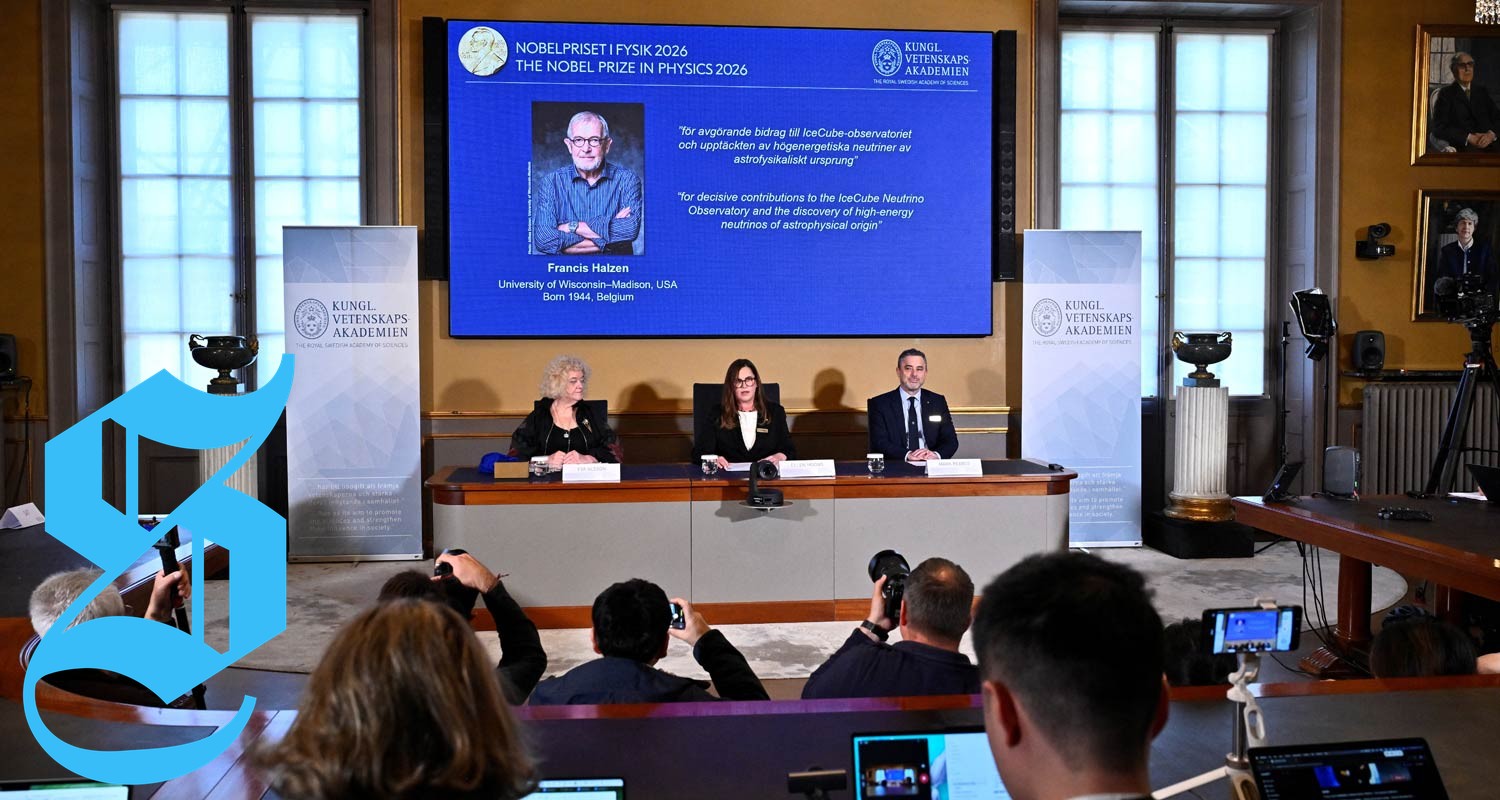
Despite celebrating this monumental achievement, Halzen humbly shared his perspective on the future outcomes of his work, emphasizing that the most significant insights may still be on the horizon:
“This is a new way of looking at the universe, and it will take bigger telescopes, many more telescopes, to become real astronomy. And what this will bring is impossible to predict.”His foresight underscores the ever-evolving nature of science and the importance of pushing boundaries in our quest to comprehend the universe.
The Nobel Prize carries a monetary reward of 12 million Swedish kronor (approximately US$1.2 million), which Halzen will formally receive during a ceremony in Stockholm on 10 December, coinciding with the anniversary of Alfred Nobel's death. Halzen's award connects him with past laureates who have also made significant contributions to neutrino studies, including Japan’s Takaaki Kajita and Canada’s Arthur McDonald, both of whom were jointly awarded the Nobel Prize in Physics in 2015.
This recognition for Halzen highlights the broader significance of neutrino research, not only for its scientific impact but also for its cultural resonance. Social media reactions to the announcement were buzzing with excitement and praise, reflecting the global appreciation for breakthroughs in particle physics. Enthusiasts and budding scientists took to platforms like Twitter and Instagram to express their admiration for Halzen's persistence and his contributions to our understanding of the universe. Comments ranged from heartfelt congratulations to discussions about the implications of neutrino research for future scientific endeavors and our understanding of the cosmos.
“Congratulations to Francis Halzen! This is a monumental achievement for neutrino science and astronomy!” posted a user on Twitter, while another chimed in with excitement, “Can’t wait to see what IceCube-Gen2 will reveal!”
These reactions signify not just a recognition of individual achievement but also a celebration of collaboration and shared knowledge across international scientific communities. The spirited discussions indicate a healthy enthusiasm for the wonders yet to be unveiled through ongoing and future neutrino explorations.
In conclusion, Francis Halzen’s Nobel Prize win for his work with the IceCube Neutrino Observatory marks a pivotal moment in physics, not only for its historic significance but also for the promise it holds for future discoveries. As we look to the stars, Halzen's legacy as a pioneer in neutrino research continues to inspire generations of scientists aspiring to answer the universe's deepest questions.



No comments yet. Be the first to share your thoughts!