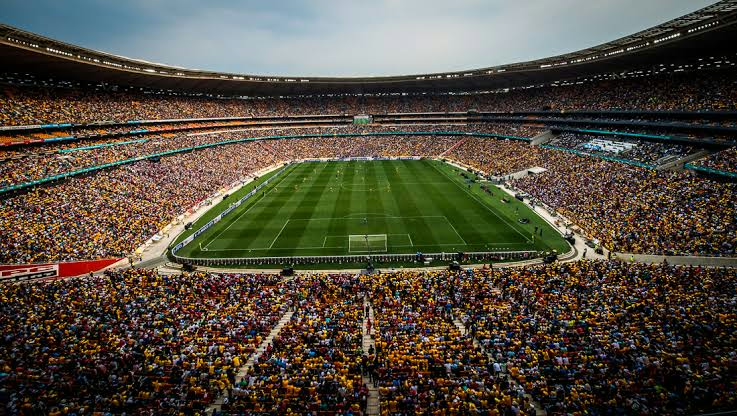
FNB Stadium Loses Major Cup Finals Due to Traffic and Safety Failures
The Premier Soccer League (PSL) has made a significant decision that changes the landscape of South African soccer: FNB Stadium, known colloquially as the Calabash due to its unique design, has been effectively blacklisted from hosting major cup finals. This choice stems from longstanding issues of traffic mismanagement and safety failures that have plagued event execution at the venue, particularly highlighted by police missteps during high-traffic matches.
Although the PSL has not ruled out a future return to FNB Stadium, their stance hinges on improvements made by local authorities, specifically the Johannesburg Metropolitan Police Department (JMPD). In conversations with league insiders, it has become evident that the PSL leadership is increasingly frustrated with the logistical challenges surrounding significant matches, especially the famed Soweto Derby. Incidents of fans arriving late have forced kick-off delays—compromising both the league’s global broadcast brand and important partnerships with corporate sponsors.
“The traffic situation has been a persistent problem,” one source remarked. “It hurts the image of the league when fans can’t even make it to the stadium on time.”
The last time FNB Stadium hosted a major cup final was in the 2011/12 season, when Orlando Pirates triumphed over Kaizer Chiefs in a dramatic 1-0 victory after extra time. Since then, it has remained largely absent from the major tournaments, marking a significant 15-year gap that raises questions about its viability for future high-profile matches.
Logistical Challenges: Duniling from FNB to Moses Mabhida
PSL CEO Mato Madlala has shed light on the rationale behind the league's preference for the Moses Mabhida Stadium, located in Durban. She emphasized the considerable support from local authorities regarding planning and security. “People are quick to forget that these games are distributed across the entire country,” Madlala stated during a recent interview on Prime Time Sport with Ukhozi FM.
Madlala further elaborated on the necessity of diverse venues for safety and logistical reasons:
“Our stance at the PSL is that we cannot rely on a single venue. If that venue—God forbid—is torched or compromised, where do we go?”
In contrast, Moses Mabhida Stadium has consistently demonstrated better planning and coordination. With successful past events, the venue ensures that fan experiences are prioritized while adhering to strict timelines. Madlala remarked on the smooth execution of events in eThekwini, highlighting the collaborative efforts with SAPS and Metro Police as critical elements.
“In eThekwini, there is nothing you request as a football administrator that they fail to deliver,” she claimed, underscoring Durban's effectiveness as a location for critical matches.
Madlala also shared a notable success story regarding the recent Soweto Derby Nedbank Cup final held at Moses Mabhida. The match not only kicked off on time but also saw an efficient dispersal of spectators, clearing the stadium within 30 minutes after the last whistle—a feat that demonstrates the impeccable planning behind the event.
The Impact on Stakeholders and Corporate Partners
The league's decision has not gone unnoticed among corporate sponsors. Kholofelo Magagane, the MTN General Manager for Brand and Marketing, reaffirmed the sponsor's full support for the PSL's venue decisions, emphasizing that:
“The decision on the final venue always rests entirely with the PSL. We appreciate wherever the PSL takes the game, and we show up with our ‘sea of yellow.’”
This statement reflects a broader sentiment within the corporate sector—an understanding that the league's choices are driven by the need for logistical feasibility and safety. However, with an eye on audience engagement, sponsors are keen to be involved in venues that promise smooth operations to ensure maximum visibility and reach.
Traffic Management Challenges: A Deep Dive
Traffic mismanagement is not merely a logistical issue; it's also a critical safety concern. In densely populated areas like Johannesburg, the influx of fans can lead to severe bottlenecks. For FNB Stadium, located in Nasrec, the access routes have presented numerous challenges in the past, often leading to frustrating experiences for fans. With the rise of social media, complaints regarding traffic conditions have surged. Fans share their experiences in real-time, amplifying the issues at hand, which in turn impacts public perception of the league and the venue.
A social media user tweeted:
“If only the PSL could see how chaotic it gets every match day at FNB Stadium, maybe they'd understand why fans arrive late!”
Such sentiments reflect the broader frustrations of attending live events, where an ailing infrastructure and poor city planning become a point of contention for soccer enthusiasts.
In contrast, Moses Mabhida Stadium benefits from its multiple ingress and egress routes, effectively accommodating large crowds without significant traffic jams. This reliability has secured its place as the preferred venue for major cup finals, amassing an impressive hosting record since its opening after the 2010 FIFA World Cup. Hosting the MTN8 final for the 11th time gives it a remarkable 65% hosting rate—an unmatched performance among stadiums in South Africa.
Outlook and Future Considerations
As discussions continue, the future remains open for FNB Stadium. The PSL has emphasized that changes will be required on the part of local authorities before they can ever consider bringing finals back to this venue. According to Madlala, progress would include improved traffic management, frequent inspections, and the establishment of stronger security protocols—all factors that assure a smooth running during major events.
The eThekwini Executive Director of Community Services, Vusi Mazibuko, has echoed these sentiments stating:
“We are committed to making sure that the next cup final is held without a hitch. Our track record speaks for itself.”
While FNB Stadium's exclusion from future major cup finals marks a significant moment in South African soccer, it also opens doors for other venues to step up and share the spotlight—encouraging a culture of excellence, collaboration, and enhanced fan experience across the nation. As the PSL continues to evolve, all eyes are now turned towards ensuring that logistics serve the game—not hinder it.


No comments yet. Be the first to share your thoughts!