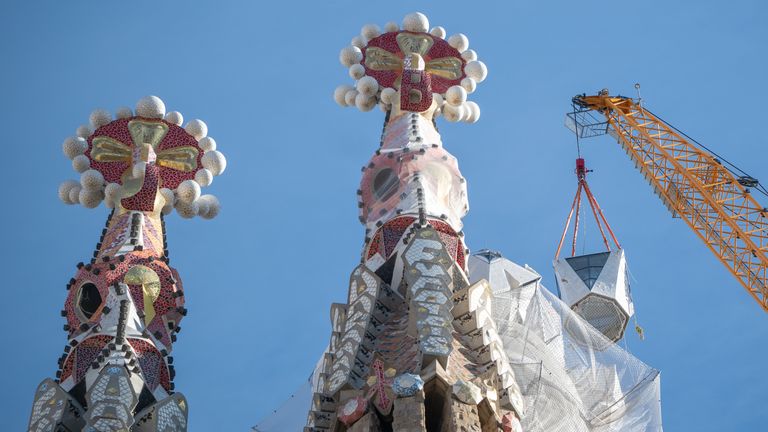
In a momentous event for both architecture and the local community, Barcelona's iconic Sagrada Familia basilica achieved a major landmark on February 20th, 2026, when a crane successfully placed the upper arm of a cross atop the Tower of Jesus Christ, marking the point of maximum height for this monumental structure.
At 566 feet, the central tower not only surpasses all other buildings in Barcelona but also stands as the tallest church in the world, a title it claimed only last year when it outstripped Ulmer Munster in Germany, a Gothic Lutheran church that took 500 years to complete.
Despite its towering achievement, the Sagrada Familia remains unfinished, with many estimates suggesting that it will not be entirely complete until 2030 or later. This prolonged construction effort is a testament to the difficult work involved in bringing Antoni Gaudi's elaborate visions to life. Gaudi, who dedicated over 40 years of his life to the basilica before his untimely death in 1926, imagined a spectacular fusion of nature and spirituality, conveying profound Christian beliefs through naturalistic forms.
The placement of the cross is particularly significant as it precedes celebrations to honor the centenary of Gaudi’s death, slated for June 2026. Rev. Josep Turull, the rector of Sagrada Familia, emphasized the importance of the central tower, stating that it will be a focal point for both faith and tourism in the city.
“This cross, characterized by its four arms, has been designed to be visible from any direction, reinforcing the basilica’s role as a spiritual lighthouse,” Rev. Turull explained in a statement. He also noted that if approved by local authorities, the cross will emit light from its arms, creating a breathtaking beam that adds to the church's symbolism.
As the scaffolding around the central tower is scheduled to be dismantled ahead of Gaudi's centenary celebrations, many anticipate a rise in visitors eager to experience the radiant beauty of the Sagrada Familia. Millions flock to this emblematic structure each year, drawn by its unique architectural style that merges Catholic iconography with organic elegances reflective of nature.
The inside of the Tower of Jesus Christ, which will hold significant religious ceremonies, continues to be a focus of construction, with scaffolding still surrounding its perimeter. While work progresses, the church remains a vital source of funding for ongoing construction, as admission fees collected from visitors are channeled directly into the development of this artistic project.
The Sagrada Familia commenced construction in 1882, with its foundations deeply rooted in the Catalan identity, representing a monumental undertaking in architectural history. Gaudi held a vision that was far ahead of his time, blending Gothic, Art Nouveau, and modernist design elements that form an unparalleled skyline above Barcelona.
The cross installed atop the Tower of Jesus Christ bears a special significance. A prayer verse from the Gloria, commonly recited by Catholics during mass, is inscribed at its base, promoting a deep sense of reverence. “You alone are the Holy One, you alone are the Lord, you alone are the Most High,” reads the inscription, encapsulating the spiritual essence of this monumental work.
Highlighting the significance of this achievement, social media has erupted with expressions of awe and reverence. Users across various platforms shared their excitement, posting images and live-streaming the installation process. Messages of congratulations were abundant, with one user capturing the spirit of the moment:
“What an astonishing architectural marvel! Gaudi’s dream is truly becoming a reality.”Another user remarked on the spiritual impact of this cross, expressing that
“This is not just a monument, but a beacon of hope and faith for many.”
In the lead-up to the centenary celebrations, Sagrada Familia is set to feature several events aimed at showcasing Gaudi’s rich legacy. As Barcelona gears up for these festivities, the cultural and historical significance of Gaudi's work will once again take center stage, reminding the world of the architectural genius that continues to shape the identity of the city.
The Sagrada Familia thus stands not only as a religious site but also as a cultural emblem for Barcelona—an ongoing narrative of human creativity, faith, and artistic expression intertwined through time.


No comments yet. Be the first to share your thoughts!