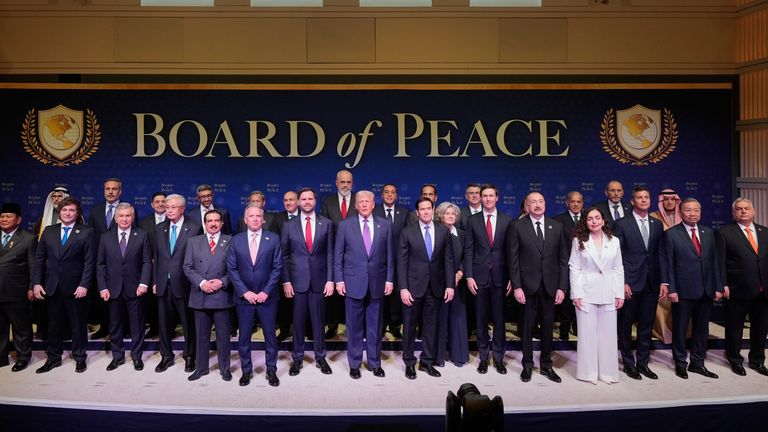
In a significant move aimed at fostering stability in the war-torn region of Gaza, Donald Trump's newly formed Board of Peace announced a substantial pledge of $7 billion to assist in rebuilding efforts. This ambitious commitment was articulated during the board's inaugural meeting held in Washington D.C. and has already sparked a wide range of reactions both domestically and internationally.
The financial support comes from nine nations represented on the board and aims to restore the Palestinian territory, which has been devastated following two years of tumultuous conflict between Israel and Hamas. Trump framed this financial infusion as "an investment in stability"—a necessary step toward forging a pathway to peace. However, despite this monumental promise, experts have pointed out that the sum only represents a fraction of the estimated $70 billion required for comprehensive reconstruction efforts in Gaza.
Kazakhstan, Azerbaijan, the United Arab Emirates, Morocco, Bahrain, Qatar, Saudi Arabia, Uzbekistan, and Kuwait were among the nations that pledged to contribute financially. Additionally, countries such as Indonesia, Morocco, Kazakhstan, Kosovo, and Albania committed to send military personnel to support an international stabilization force, initially stationed in the city of Rafah, a key population center in southern Gaza. This deployment marks a pivotal effort to establish security in a region that has struggled to achieve a lasting peace.

Mr. Trump also noted that Egypt and Jordan pledged their assistance in training police forces. The shared vision among these nations reflects a collaborative approach to addressing security and stability concerns in Gaza, which the United States views as a crucial aspect of fostering a peaceful future in the region.
During the meeting, Trump expressed gratitude towards the donors and emphasized that "every dollar spent is an investment in stability, and the hope of a new and harmonious region." His remarks resonated within the context of a broader peace initiative, one encapsulated by the board itself. "The board is demonstrating how a better future can be constructed right here within these discussions," he said, invoking a sense of urgency and hope amid ongoing strife.
The board was established as part of Trump’s ambitious 20-point peace plan designed to resolve the persistent conflicts surrounding Gaza, catalyzing discussions during a fragile ceasefire that was implemented in October after intense hostilities. Major General Jasper Jeffers, the head of the newly organized International Stabilization Force, highlighted the need for a substantial security presence, detailing plans for an initial deployment of 20,000 soldiers and 12,000 police officers to facilitate peacebuilding efforts.
Photographs shared from the meeting portrayed stark contrasts—images of communities gathering for traditional Ramadan meals amidst the ruins, amplifying the humanitarian crisis that continues to unfold. The visual narrative underlines the precarious balance between hope and despair in a region yearning for recovery.

Since launching in August, Trump's Board of Peace has transitioned its objective from merely seeking lasting solutions between Israel and Hamas to addressing broader global conflicts, which has led to some critics alleging that Trump envisions the board as an alternative to the United Nations. In response to such critiques, Trump asserted, "the UN is going to be much stronger, and the Board of Peace is going to be overseeing the United Nations, ensuring it operates effectively." This assertion underlines the administration's intent to reshape diplomatic engagements through a new lens.
The meeting saw participation from around 50 nations, including representatives from the United Kingdom, which, though not a member of the board, sent officials as observers. Important European nations, including Germany, Italy, Norway, and Switzerland, also observed the proceedings, reflecting a growing international interest in the long-term prospects for peace in Gaza.
As the details of these agreements unfold, social media platforms have erupted with mixed reactions. Some users expressed optimism over the potential for reconstruction and stability, while others voiced skepticism, questioning whether this initiative could truly succeed in changing the dynamics of a conflict that has persisted for decades.
"Can we really believe that this money will lead to lasting peace? History shows otherwise,"one user lamented, encapsulating a sentiment echoed by many who are cautious about the effectiveness of international interventions.
Meanwhile, influential commentators on Twitter noted the significance of the timing of this announcement, emphasizing that previous promises of aid have often fallen short.
"$7 billion is a start, but can it really rebuild a devastated region? We must remain vigilant and critical,"cautioned another commentator, highlighting the necessity for accountability in these assistance programs.
Additionally, the political landscape in the US has also reacted unfavorably, with opposition leaders questioning the origins of the pledged funds and criticizing the lack of clarity surrounding Trump's $10 billion allocation for the board.
"What does $10 billion even mean without a clear plan? This feels like more rhetoric than substance, and the people of Gaza deserve better than just words,"remarked a prominent figure, signaling a growing concern regarding transparency and effectiveness in foreign assistance.
In a recent announcement, Trump warned Iran of the consequences if meaningful agreements are not reached, reflecting the interconnected nature of regional conflicts and the heightened stakes involved in any peace process. "We have to make a meaningful deal. Otherwise, bad things happen," he stated, sending a message that reverberates through diplomatic circles worldwide.
As the Board of Peace moves forward, the challenges of executing a coherent and effective strategy in Gaza loom large, amidst a backdrop of skepticism and concern about previous international intervention efforts. With the world watching, every decision made in the coming months will undoubtedly influence not only the future of Gaza but also the broader geopolitical landscape of the Middle East.



No comments yet. Be the first to share your thoughts!