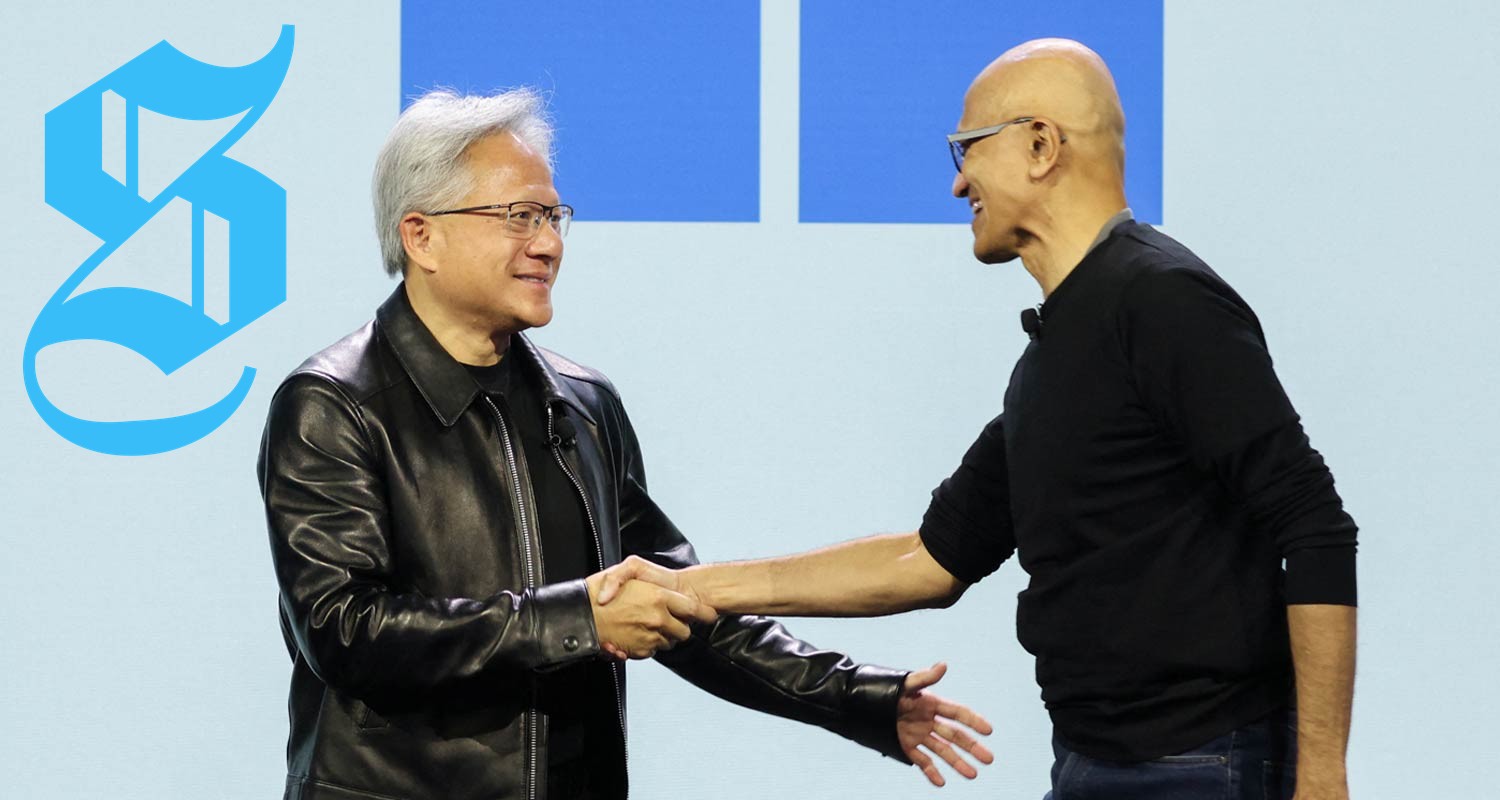
Microsoft on Wednesday unveiled a transformative AI coding model with the capacity to operate directly on personal computers, taking a significant step towards enhancing the integration of artificial intelligence in everyday technology. This initiative arrives amidst Apple's own endeavors to introduce greater AI capabilities into its products, marking a competitive moment in the tech industry.
At a high-profile event held in San Francisco, the software giant also revealed the high-powered Surface Laptop Ultra, which is equipped with Nvidia’s advanced RTX Spark chips. This move signifies Microsoft's aim to transition Windows into a robust platform where AI agents can handle tasks typically reserved for cloud computing, including writing complex code or managing intricate business projects.
For Microsoft, this push not only challenges existing norms but represents a pivotal bet that certain workloads currently relegated to expensive Azure cloud computing data centers can successfully migrate to high-performance Windows machines located in homes and businesses—where Microsoft maintains a stronghold. This potential shift presents a lucrative avenue that rival Apple is also keen on exploring with its new range of Mac computers.
Nvidia, alongside Microsoft, sees this as a golden opportunity to penetrate the Windows PC market, an arena still largely dominated by competitors like Intel and AMD. “Having our technology in such influential products could enable a broader adoption of AI across various sectors,” stated Nvidia CEO Jensen Huang during the unveiling.
Amid rising concerns regarding AI's autonomous capabilities, Microsoft introduced the Microsoft Execution Containers—a tool designed to prevent AI agents from unauthorized data access and actions when operating on personal machines. Pavan Davuluri, Microsoft’s executive vice-president for Windows and devices, reassured audiences about the enhanced security capabilities.
“We needed to make the desktop the most secure place for agents to execute,” said Microsoft CEO Satya Nadella.
Davuluri highlighted that this new approach will empower IT departments to establish regulations for AI agents, ensuring Windows enforces these rules on each user’s device, thus fortifying the security infrastructure amidst increasing automation.
Building and Deploying AI Agents
During his presentation, Nvidia CEO Jensen Huang noted the potential breakthroughs of Microsoft’s execution container technology, tenderly referred to as MXC, adding that it could significantly revolutionize how AI agents are constructed and implemented. Huang emphasized,
“Without it, agents are a complete non-starter.”
With rising security incidents—like the high-profile hack of AI hub Hugging Face—both Microsoft and Apple are striving to regulate AI agents’ access to sensitive data infrastructures. This measures serve as a safeguard against potential breaches that could arise from more independent AI behaviors.
In an ambitious stride, Microsoft’s AI models are beginning to showcase their ability to run locally on high-spec Windows devices. This includes innovative models such as Nvidia’s open-source Nemotron, which—according to Davuluri—could outperform OpenAI’s GPT-5 in specific coding and reasoning challenges for desktops equipped with at least 60GB of memory.
Demonstrating a sophisticated approach, Microsoft’s own Copilot AI assistant intends to harmonize tasks between cloud systems and local capacity.
“Copilot will still use the cloud for the hardest tasks, but for times when cost or privacy matter more, it can delegate down to local models that run directly on your computer,”explained Jacob Andreou, the head of Microsoft’s Copilot project.
Davuluri expanded on this topic, announcing that Meta’s Muse personal assistant would also make its debut on Windows devices as a native application, benefiting from Microsoft’s new security protocols. The emerging open-source AI agent system, OpenClaw, is also poised to integrate seamlessly with these security solutions.
Confronting the Price Barrier
While the developments are undeniably exciting, both Microsoft and Nvidia face considerable hurdles—most notably, the exorbitant pricing attached to these new devices, a challenge exacerbated by a recent memory chip shortage that has inflated costs across the market.
The new Surface Laptop Ultra will retail starting at $2,599, reaching up to $5,899 for fully loaded configurations boasting a 20-core processor, 128GB of memory, and 1TB of storage. In comparison, Apple’s equivalent MacBook Pro—featuring a 40-core graphics chip and similar memory and storage specifications—comes in at a hefty $6,700. Although direct comparisons might prove challenging, it’s notable that Microsoft’s entry-level Ultra is priced above Apple’s base MacBook Pro, which starts at $1,999 and includes lesser specs: 24GB of model versus 16GB in Apple’s offering.
Insider analysis finds that when Microsoft began introducing AI capabilities two years ago, many of these laptops were anticipated to be available for under $2,000. However, in a market where Nvidia has increased the price of its AI desktop solution, DGX Spark, by approximately 75% to $6,950, consumers face a sobering reality.
According to Anshel Sag, an analyst at Moor Insights & Strategy,
“Two years ago, the software wasn't ready, but the hardware was. Now the software is ready and the hardware is too expensive to actually run it locally. So it’s becoming this thing where only the people who have the budget can really afford to run AI locally.”This trend could hinder accessibility and stall widespread adoption among everyday consumers.
As social media reacts to the announcement, sentiments are mixed. Enthusiasts and industry insiders are excited about the potential applications of AI in everyday devices, with many sharing their predictions on how these advancements can streamline workflows and enhance productivity. But consumers are voicing concerns over cost, hoping for more affordable avenues to access AI capabilities in the near future.
With Microsoft now at the forefront of this new AI revolution, early adopters will have to weigh the benefits against the financial overhead as they navigate through this transition in PC technology.
Reported by Stephen Nellis in San Francisco, with contributions from Jaspreet Singh and Unnamalai L in Bengaluru, © 2026 Reuters
No comments yet. Be the first to share your thoughts!