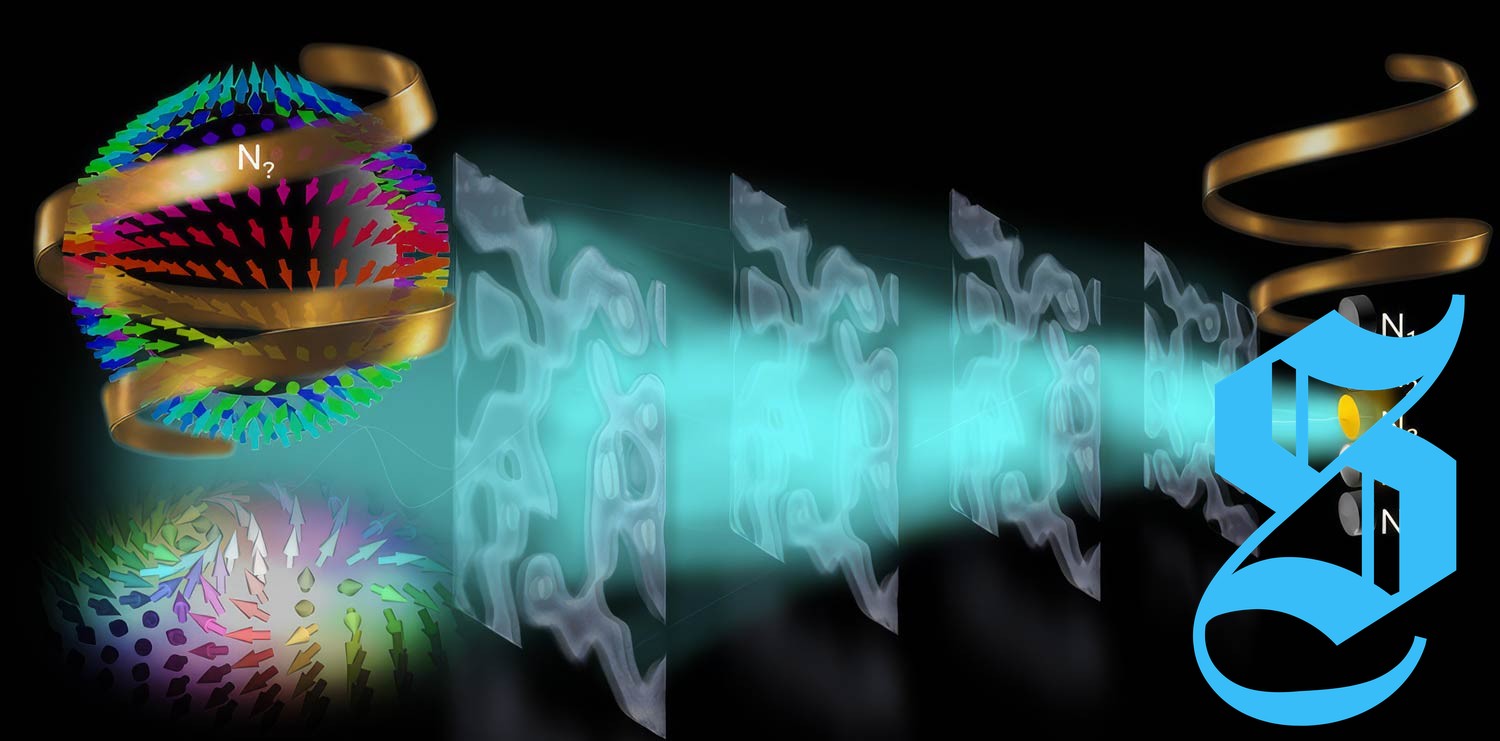
Researchers at Wits University have made a significant breakthrough in the world of optical technology by developing what is being referred to as a "light-powered brain". This innovative optical neural network can recognize intricate information hidden within complex patterns of light without the need to first capture a detailed image. This groundbreaking development, published in Nature Communications on October 7, aims to revolutionize optical communications by enhancing speed and reliability.
The implications of this technology are immense. Each light pattern could represent a unique symbol, theoretically allowing a single pulse of light to convey more information than traditional methods currently allow. This could touch various fields such as laser communication between buildings or even to satellites—where turbulence often complicates the transmission of beams. The research team optimistically points at a wide array of potential applications in sensing, imaging, and even quantum communications. They posit that a trained detector could be integrated into fixed optics that require no power, making it a highly efficient solution.
This innovative project, helmed by MSc student Hadrian Bezuidenhout and supervised by Isaac Nape and Andrew Forbes at the Wits Structured Light Laboratory, has made impressive strides in overcoming existing limitations associated with the use of shaped or "structured" light for communications.
The Challenge and Solution
Light can be manipulated into patterns that function like letters in an alphabet, yet these letters are rendered useless if a receiver cannot quickly interpret them, particularly when those light patterns experience alterations during transmission. Nape stated,
“Creating light patterns that form large alphabets for communications is only useful if we can read them as fast as we can create them.”Thus, the research team set out to find a more efficient and effective solution.
Instead of capturing and analyzing thousands of individual points as done through conventional methods, the recent work employs a simplified approach. The light is transmitted through two channels, each featuring five diffractive layers. This design channels the light towards different spots on a detector, where the position of the light landing allows researchers to read the skyrmion number of the transmitted light. Remarkably, in this laboratory setup, the patterns aren’t physical components but are instead displayed on a spatial light modulator, a sophisticated device programmed to reshape light.
Bezuidenhout emphasized,
“We don’t need to map every crease in our fabric of light to count the twists. Our network picks out the information that matters and helps us identify the topology quickly.”This approach favors efficiency, allowing the network to be trained live on the optical bench effectively.

The Magic of Skyrmions
The optical patterns in question are termed optical skyrmions, described in the research as “topological forms of structured light offering an unbounded encoding alphabet robust to perturbations.” Each skyrmion carries a whole number—its skyrmion number—that remains invariant even amidst distortion. Nape likens this phenomenon to a twisted ribbon: irrespective of how one bends or folds it, the number of twists remains constant. This mathematical feature falls under the field of topology, which studies properties that remain unchanged under continuous transformations.
Nevertheless, interpreting the skyrmion number has historically been a challenging task. Traditional methods required capturing an intricate image, a process which can be laborious and unyielding. However, this new method has shown to be overwhelmingly successful. The Wits team’s system was able to recognize nine basic light modes within its two polarisation channels and correctly identify skyrmion numbers from 81 structures spanning 15 different values with an impressive accuracy rate of about 93%. In fact, the authors likened this efficiency to “model generalisation in neural networks.” The detector held strong even in conditions of heavy interference, maintaining 100% accuracy until the noise peak reached about 95% of the intensity of the actual signal.
The researchers have already tested the system to transmit and decode an image encoded in a 15-letter topological alphabet, showcasing the practical applications of their theoretical findings. While this remains a limited laboratory demonstration and not yet a fully functional communication tool, it marks a significant step toward overcoming some of the inherent challenges tied to light communication.
The Intersection of AI and Physics
The synergy between traditional physics and modern artificial intelligence here has not gone unnoticed. Benjamin Rosman, director of the Mind Institute, applauded the research team's cross-disciplinary approach, stating
“This research is a wonderful example of what becomes possible when we bring together ideas from artificial intelligence and fundamental physics. By embedding neural network principles directly into the behaviour of light, the team is opening up new possibilities for how we process information.”
Andrew Forbes, who leads both the South African Quantum Technology Initiative (SA QuTI) and the Wits Quantum Initiative (WitsQ), expressed optimism about this advancement’s impact on future networks.
“At the Structured Light Laboratory, we are exploring how topology could support a future quantum and classical internet. But creating these light structures is only part of the challenge. We also need practical ways to read them, and that measurement toolbox is still taking shape. This work shows how reaching beyond photonics can help us build it,”he said.

Future Implications and Spin-Offs
The laboratory has already spun off a new company, Button Optics, which specializes in structured-light systems for secure communications and imaging; they have launched their first product—a quantum-inspired toolkit—ready for market. As for the Wits researchers, they express profound enthusiasm about what lies ahead.
Nape articulated their ambition, stating,
“We hope this is just the beginning. Beyond topology, we want to explore how optical intelligence can contribute to quantum technologies in South Africa. Extracting information from individual particles of light presents even greater measurement challenges, and we are excited to investigate how these tools could help us tackle them.”
The intersection of artificial intelligence, optical science, and quantum technology suggests exciting possibilities for the future. By continuing this multidisciplinary approach, Wits University is positioning itself at the forefront of pioneering research that promises to transform industries and communications in the years to come.
As the digital world grows increasingly reliant on effective data transmission, innovations like the light-powered neural network could prove indispensable, bridging gaps between current limitations and future demands for efficient communication.



No comments yet. Be the first to share your thoughts!